2D design development
Concepts and sketches resolved into proportioned drawings and specifications.
Technology & quality · Digital development
Every piece is modelled, reviewed and refined digitally. Explore a demonstration model: switch finishes, open the exploded view and rotate it freely.
Finish
View
 Interactive 3D is not available in this browser.
Sketch → 3D → wax → sample
Concepts are resolved into proportioned drawings with materials, stones and construction defined.
Geometry, stone layout and wall thickness are modelled precisely, then rendered for review.
The approved model is printed in wax — the physical master used for review and casting.
The wax is cast in the agreed metal, then filed, set and polished into a reference sample.
Inside the workshop
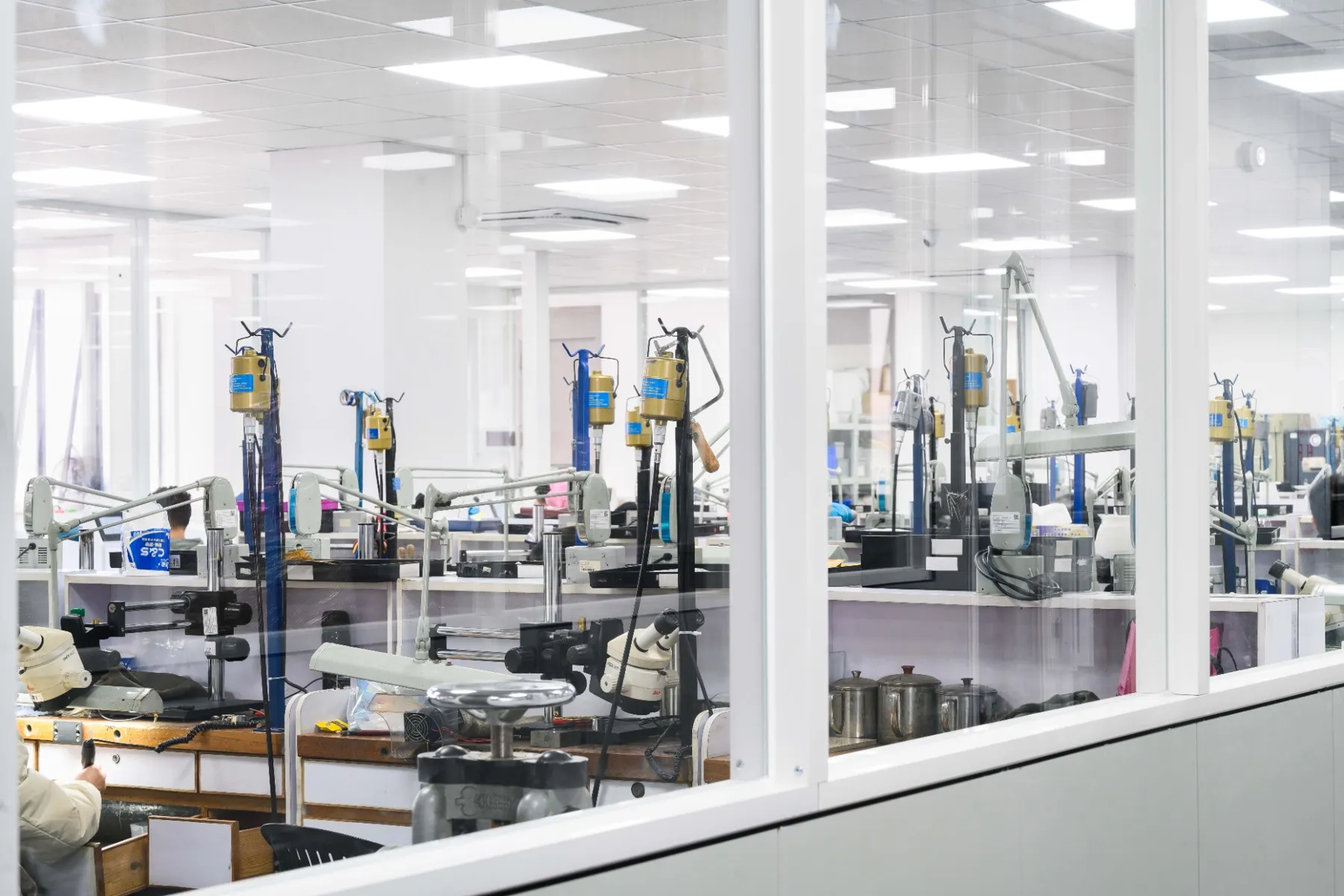
Design, digital development and specialist craft are coordinated in-house, so each step is reviewed against what came before it.
Concepts and sketches resolved into proportioned drawings and specifications.
Rhino and Matrix models define geometry, stone layout, wall thickness and construction.
Rendered views let you review the design in metal and stone before a sample exists.
Approved CAD printed as a high-resolution wax master for review and casting.
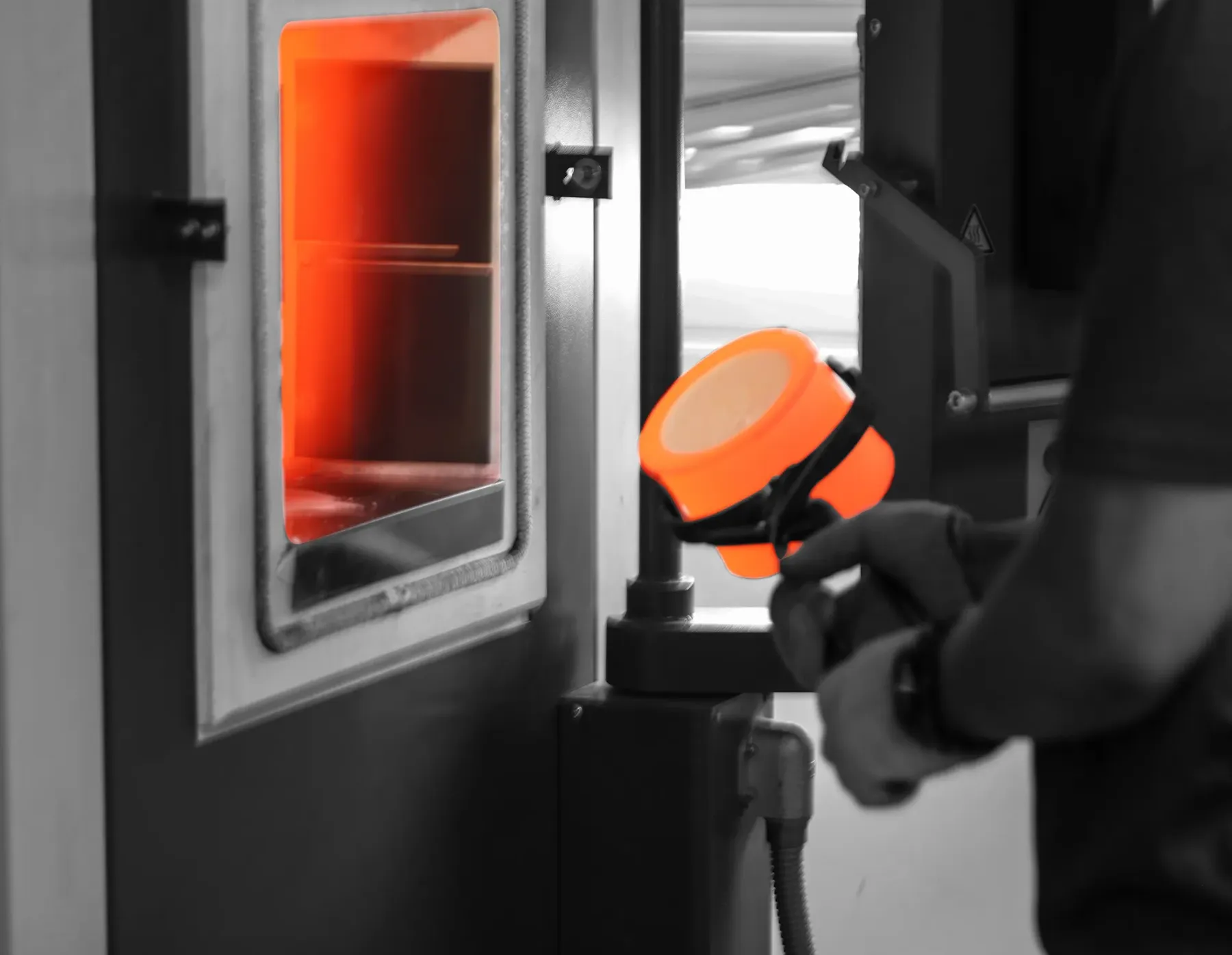
Wax masters are treed, invested in plaster and lost-wax cast in the agreed metal.
Cast parts are cleaned, filed and joined with precise, localised laser welds.
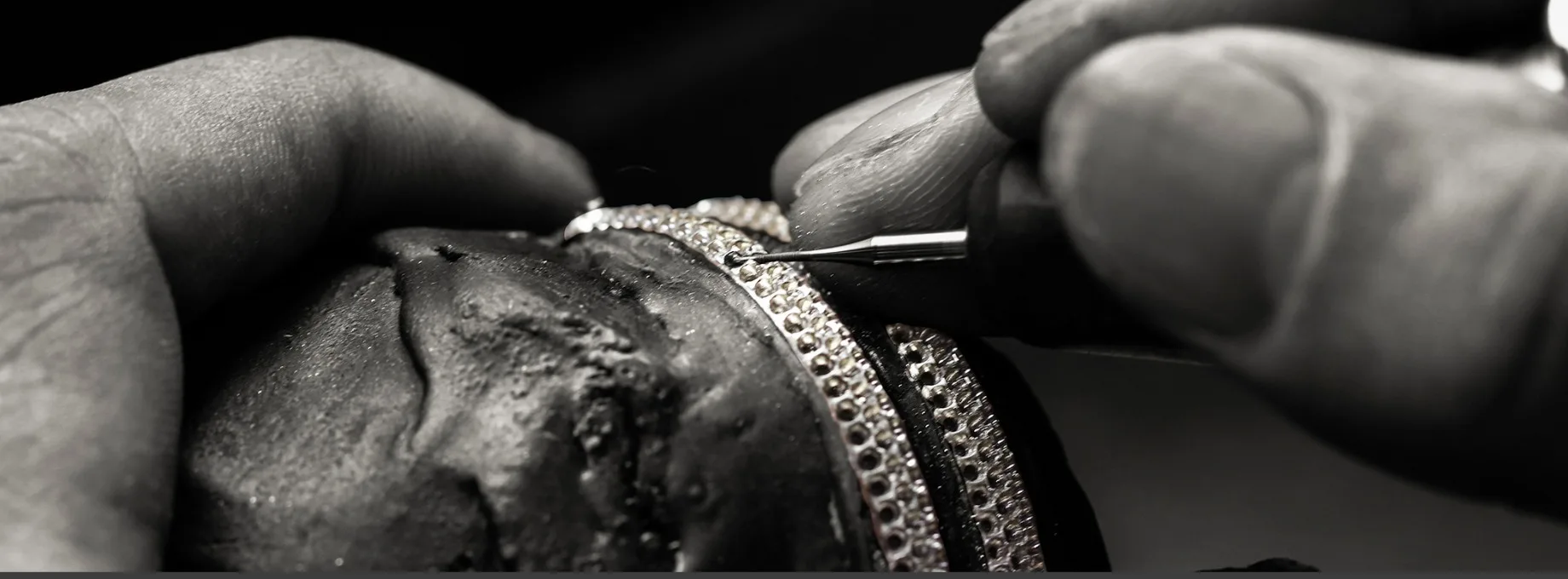
Prong, bezel, channel, pavé and micro-pavé setting carried out by hand under magnification.
Every surface refined by hand — from mirror polish to satin and textured finishes.
Rhodium plating for a bright white finish, with selective plating for two-tone designs.
Logos, hallmarks, serials and personal messages engraved with fine laser detail.
Each piece checked against the agreed specification before release.
Inside the ACCA facility
Our facility of more than 7,000 m², as a model: four floors, one department on each, a room for every technique. Choose a floor and zoom in to explore it, then choose a room to watch its technique in 3D, narrated.
Click a floor to step inside
Illustrative model. Floor plans simplified.
Choose a floor and a room below.

Specialist techniques
The techniques that turn a precise model into finished fine jewellery. Watch each one in 3D with narration from our bench — choose a discipline and a technique, drag to turn it, or let the sequence play.
CAD to castable pattern
A high-resolution printer builds the CAD model layer by layer in castable resin, producing a precise pattern ready for investment casting.
At ACCA, every approved CAD model becomes a physical pattern before any metal is cast. The file is sliced into layers of around twenty-five microns. With each pass, the build plate dips into castable resin, and ultraviolet light cures one exact cross-section. Prong tips, pavé seats and filigree survive at full resolution. The finished pattern rises from the vat, is washed and post-cured, and is checked against the CAD before it goes to the casting room.
Narration uses a synthetic voice.
Lost-wax process
Wax masters are assembled on a tree, invested in plaster and burnt out. Molten metal fills the cavity, reproducing every detail of the model.
Investment casting is the backbone of the ACCA casting room. Wax or resin patterns are sprued onto a central trunk to form a tree, sealed in a steel flask and invested in plaster. A slow burnout cycle, rising to around seven hundred and thirty degrees, removes every trace of the pattern. Molten eighteen-karat gold, at roughly one thousand and fifty degrees, is then drawn into the cavity under vacuum. When the plaster is quenched away, the gold carries every detail of the original model.
Narration uses a synthetic voice.
Hammer and anvil
Metal is heated and shaped with the hammer, compacting the grain for strength and giving each piece a solid, hand-made form.
Hand forging gives metal a density that casting cannot match. At ACCA, a gold or platinum bar is annealed to a dull red glow, then worked on the anvil with measured, overlapping blows. Each strike compresses the grain and drives out porosity, so the finished band is harder and more resistant to wear. The bar is drawn down, curved over the horn, and finally closed into a ring, ready to be soldered, trued and sized.
Narration uses a synthetic voice.
Restoring workability
Metal hardened by hammering, rolling or drawing is heated to a dull glow and cooled, softening it so it can be shaped again without cracking.
Every time metal is hammered, rolled or drawn, it work-hardens and becomes brittle. Annealing restores it. At ACCA, the coil is brought evenly to a dull cherry red: for eighteen-karat yellow gold, roughly six hundred and fifty degrees, held just long enough for the grain to recrystallise. It is then quenched, pickled clean, and returned to the bench soft and ready. This cycle of work and anneal is repeated at every forming stage, so the metal never cracks.
Narration uses a synthetic voice.
Ingot to sheet
A cast ingot is passed repeatedly through polished steel rollers, reducing it to sheet or strip of precise, even thickness.
The rolling mill turns a cast ingot into sheet or strip of exact thickness. At ACCA, the ingot is fed between hardened, polished steel rollers. Each pass reduces it by only a small fraction, with annealing in between, until it reaches the gauge specified on the technical sheet, often to within two hundredths of a millimetre. The result is dense, even stock for bezels, galleries and backing plates. Patterned rollers can also print texture into the surface.
Narration uses a synthetic voice.
Through the drawplate
Wire is pulled through successively smaller holes in a drawplate until it reaches the exact gauge and profile required.
Wire drawing produces the exact gauges that prongs, jump rings and chain depend on. At ACCA, annealed wire is tapered at one end, fed through a tungsten carbide drawplate and pulled through one hole after another, each slightly smaller than the last. Round, square and half-round profiles are made the same way. A prong wire that is a tenth of a millimetre too thin is a security risk, so every gauge is measured with a micrometer before it reaches the setter.
Narration uses a synthetic voice.
Folded, forged, unfolded
Sheet metal is folded, forged along the fold and opened out, creating organic, three-dimensional forms from a single flat piece.
Fold forming creates sculptural volume from a single flat sheet. At ACCA, an annealed sheet is folded and the fold line is forged with a cross-peen hammer. The metal stretches far more along the fold than at its edges. When the sheet is opened, it springs into a curved, leaf-like form that could not be raised any other way. The result is light, rigid and organic, suited to statement earrings and limited editions.
Narration uses a synthetic voice.
Saddle-curved forms
Metal is stretched along one axis and compressed along the other over a sinusoidal stake, raising elegant saddle curves for cuffs and bangles.
Anticlastic raising produces a saddle curve: the metal bends one way along its length and the opposite way across its width. At ACCA, a flat strip is laid in the groove of a sinusoidal stake and struck with a narrow raising hammer, stretching the edges while the centre is compressed. The double curvature makes a cuff remarkably stiff for its weight, so a bangle can be both light and strong.
Narration uses a synthetic voice.
Capillary joins
Solder melts under the torch and flows along the seam by capillary action, joining parts with a strong, invisible line.
Torch soldering creates joins that disappear. At ACCA, two parts are filed to a light-tight seam, fluxed, and a small paillon of solder is placed on the line. The torch heats the whole assembly, not the solder, until the alloy flows and capillary action draws it along the join. Hard, medium and easy solders melt at stepped temperatures, so later joints never reopen earlier ones. Solder is matched to the karat, so the line stays the same colour as the piece.
Narration uses a synthetic voice.
Precise, localised joins
A pinpoint laser joins components close to stones and delicate areas, keeping heat away from the rest of the piece.
Laser welding joins metal where a torch cannot go. At ACCA, the operator aligns the parts under a stereo microscope, and a pulsed laser delivers a spot about two tenths of a millimetre across. The metal fuses in milliseconds, and the heat stays local, so a stone set a millimetre away is not affected. The technique is used for assembly near stone seats, for re-tipping prongs, and for repairs that must leave no visible trace.
Narration uses a synthetic voice.
Link by link
Wire is coiled, cut into rings and each link is threaded, closed and soldered, building a supple chain one link at a time.
Chain is built at ACCA one link at a time. Drawn wire is wound tightly around a steel mandrel, and the coil is sawn into identical jump rings. Each ring is opened, threaded through its neighbour, closed flush and soldered, so no link can pull apart under load. The chain is then shaped into cable, curb or rope, cut to the length on the specification, and finished with its clasp.
Narration uses a synthetic voice.
Secure, precise fittings
Box clasps, hinges and safety catches are built from tube and sheet, then fitted to fine tolerances so they close with a firm, clean click.
A clasp is a small mechanism that has to work for years. At ACCA, box clasps are fabricated from tube and sheet: a precisely cut box, and a folded spring tongue that compresses as it enters and expands behind the catch. The fit is adjusted to tenths of a millimetre so it closes with a firm, audible click. A hinged safety catch is then added, and every clasp is opened and closed repeatedly before it is approved.
Narration uses a synthetic voice.
Measured and matched
Stones are measured, sorted and matched for size and colour before setting, so layouts sit evenly and consistently.
Even layouts start with matched stones. At ACCA, loose stones are measured with gauges and electronic callipers, and sorted into size bands often only a few hundredths of a millimetre apart. They are then graded for colour against reference stones under daylight-balanced light. Only stones from the same band go into one eternity band, halo or line bracelet, so every seat fits and the finished surface looks uniform from edge to edge.
Narration uses a synthetic voice.
Cutting the gem
Rough crystal is mounted on a dop and ground against a rotating lap, facet by facet at exact angles, then polished to release its brilliance.
Lapidary faceting turns a rough crystal into a cut stone. The rough is mounted on a dop and set in a faceting head that locks each angle to a fraction of a degree. At ACCA, our lapidary partners grind every facet against a diamond lap, working through the pavilion and the crown, then polish each facet in turn. The angles are chosen so that light entering the table reflects back to the eye. The same skills are used to re-cut and calibrate stones for a design.
Narration uses a synthetic voice.
Smooth domed stones
A slab is sawn, shaped and domed on graded wheels, then polished to a smooth, glossy surface that shows off colour and optical effects.
A cabochon is cut for colour and optical effect rather than sparkle. A slab is marked with a template, sawn, and ground to a precise outline. The dome is then shaped on progressively finer wheels, from coarse grit to a final polish, keeping the curve even all the way round. At ACCA, cabochons are cut to calibrated outlines, so they sit perfectly in a bezel and show the stone's full depth of colour.
Narration uses a synthetic voice.
Carved in reverse
A design is carved below the face of a stone, so it reads in relief when pressed into wax — the art of the signet.
Intaglio is carving in reverse. The design is cut below the polished face of the stone, so that pressed into wax it reads as a crisp relief. Working under magnification, the carver uses diamond burrs, from fine points to small wheels, building depth gradually and checking the impression as he goes. For signet rings, ACCA reproduces a crest or monogram to a carver's drawing, then sets the stone so the seal can still be used.
Narration uses a synthetic voice.
Under magnification
Tiny stones are set closely together and secured with minute beads of metal, creating a continuous surface of light.
Micro-pavé covers a surface in stones that are often less than one millimetre across. At ACCA, the stone layout is defined in CAD, and each seat is cut under the microscope with a bur sized to the stone. The setter places the stones one by one, then raises tiny beads of metal from the surrounding surface with a graver, pushing them over each girdle. Every bead is shaped with a beading tool and checked under magnification, so the surface reads as continuous light.
Narration uses a synthetic voice.
Hand-knotted strands
Pearls are strung on silk with a hand-tied knot between each one, protecting them from rubbing and keeping the strand safe if it breaks.
Pearl knotting protects every pearl on a strand. At ACCA, the pearls are graded for size and lustre, and strung on silk or nylon with a fine needle. After each pearl, a knot is tied and pushed firmly against it with an awl. The knots stop the pearls from rubbing against each other, and if the thread ever breaks, only one pearl can come loose. The strand is finished with gimp at each end, to protect the thread where it meets the clasp.
Narration uses a synthetic voice.
Traditional burin work
A hand-guided burin cuts scrolls, patterns and lettering directly into the metal, leaving bright, crisp cuts no machine replicates.
Hand engraving is still done with a burin. At ACCA, the piece is held in an engraver's ball vice under magnification. The engraver pushes the graver into the metal at a shallow angle and cuts a curl of gold away. Turning the work instead of the tool, he shapes scrolls, lettering and bright-cut facets that catch the light. No two hand-cut lines are identical, and that is exactly what a client is paying for.
Narration uses a synthetic voice.
Fine detail marking
A focused laser marks logos, hallmarks, serial numbers and personal messages with crisp, permanent detail.
Laser engraving marks logos, hallmarks and serial numbers with permanent precision. At ACCA, the artwork is imported as vector paths and the fibre laser traces them, vaporising a few microns of metal with each pass. Depth is set by power and the number of passes, so a mark can be a fine surface line or a deep, crisp engraving. Every mark is placed exactly where the technical sheet specifies, and checked under the loupe at final inspection.
Narration uses a synthetic voice.
Engine-turned patterns
A rose-engine lathe cuts fine, interlacing lines into the metal, creating patterns that shimmer on their own or beneath translucent enamel.
Guilloché is engine-turned decoration. A rose-engine lathe, guided by a stack of shaped cams called rosettes, moves the workpiece against a fixed cutter as it rotates. Each pass cuts one fine line; the cutter is indexed and the pass repeated, line after line, until waves, sunbursts or barleycorn patterns interlace across the surface. At ACCA, guilloché is used on its own or under translucent enamel, where the pattern glows through the colour.
Narration uses a synthetic voice.
Beaded edges
A knurling wheel rolls a row of tiny beads along edges and settings — a vintage-inspired detail that frames stones and outlines.
Milgrain adds a row of tiny beads along an edge. At ACCA, a hardened knurling wheel, sized to the bead required, is rolled along the edge with steady pressure, and each notch in the wheel raises one bead of metal. The beading frames stones and outlines with a fine, vintage detail. The line must stay straight and every bead the same size, so the work is done under magnification.
Narration uses a synthetic voice.
Faceted metal surfaces
A diamond-tipped cutter carves precise facets into the metal surface so it catches and returns light like a gemstone.
Diamond-cut finishing carves facets into the metal itself. At ACCA, the piece is mounted in a precision cutting machine and a diamond-tipped tool takes a single, clean cut for each facet, leaving a surface that is already mirror-bright. Facets are indexed around the band at fixed angles, so they flash in sequence as the piece turns. The result is sparkle without stones, repeatable from the first piece to the last.
Narration uses a synthetic voice.
Gold in tiny spheres
Minute gold granules are arranged in patterns and fused to the surface without solder — an ancient technique of extraordinary precision.
Granulation is one of the oldest techniques in goldsmithing. Tiny gold spheres are made by melting fragments of gold until surface tension pulls each one round. At ACCA, the granules are placed one by one in their pattern, held with a copper-salt glue, and heated until the copper and gold diffuse into one another. The granules fuse to the surface without solder, so every sphere stays perfectly crisp.
Narration uses a synthetic voice.
Lace in metal
Fine twisted wires are curled and soldered within a frame, creating open, lace-like ornament of remarkable lightness.
Filigree is lace made of metal. Fine gold wire is twisted, then flattened slightly so it catches the light. At ACCA, the craftsman bends it with tweezers into scrolls and spirals and packs them tightly inside a heavier frame wire. Powdered solder is applied, and the whole panel is heated at once, joining every contact point. The result is open, light ornament for earrings and pendants.
Narration uses a synthetic voice.
Relief from both sides
The design is pushed out from the back and refined from the front with punches, giving sheet metal sculpted, three-dimensional relief.
Chasing and repoussé create relief from a flat sheet. At ACCA, the design is transferred to the metal and the sheet is set in warm pitch, which supports it while it moves. Working from the back, the chaser drives the forms outward with rounded punches. The piece is then turned over, re-set in the pitch, and the detail is refined from the front with tracers and matting tools. Raised, sculpted relief is achieved without removing any metal.
Narration uses a synthetic voice.
Wood-grain metal
Layers of contrasting metals are bonded into a billet, carved and rolled flat, revealing a flowing pattern like the grain of wood.
Mokume-gane is Japanese for wood-grain metal. Alternating sheets of contrasting alloys are stacked and diffusion-bonded under heat and pressure into one solid billet. At ACCA, the billet is then carved or drilled through its layers, and forged and rolled flat again. The cuts expose the layers as flowing rings and waves, so every band carries a grain that is unique.
Narration uses a synthetic voice.
Gold foil on silver
Thin 24K gold foil is burnished onto heated silver, forming a permanent bond and a crisp two-colour design.
Keum-boo is a Korean technique for bonding gold onto silver. At ACCA, the silver is first depletion-gilded, building up a layer of fine silver at the surface. Pure twenty-four-karat gold foil, only microns thick, is cut to the design. The piece is heated to around three hundred and fifty degrees, and the foil is pressed down with an agate burnisher until the two metals diffuse into a permanent bond: bright gold detail on white silver.
Narration uses a synthetic voice.
Black in bright metal
A black metallic alloy is fused into engraved recesses and polished flush, so the design reads crisp and dark against bright metal.
Niello is a black sulphide alloy of silver, copper and lead. At ACCA, the design is engraved deeply into the metal, and the niello is ground to a powder and packed into the cuts. Gentle heat melts it so that it flows into the recesses and fuses there. Once it has cooled, the surface is filed, stoned and polished flush, leaving crisp black lines set into bright metal. The contrast is strong, and it will not wear away.
Narration uses a synthetic voice.
Colour fused to metal
Powdered glass is laid into cells and fired, fusing a durable, vivid colour to the metal surface.
Enamelling fuses coloured glass to metal. At ACCA, finely ground enamel is washed, then laid wet into each cell, in champlevé recesses or between cloisonné wires. The piece is fired in a kiln at around eight hundred degrees, and the glass melts into a smooth, glossy layer. Several thin layers are built up and fired in turn for depth, then stoned flush and refired. Colours can be matched to a brand reference.
Narration uses a synthetic voice.
Enamel without a back
Translucent enamel is fired into open cells with no backing, so light passes through it like a stained-glass window.
Plique-à-jour is enamel without a back, light shining through it like stained glass. At ACCA, the frame is pierced into open cells, and each cell is filled with translucent enamel held in place only by surface tension. It is fired on a temporary mica backing, which is removed once the glass has fused to the walls. After several firings, the cells are stoned and polished, and the colour glows when the piece is held to the light.
Narration uses a synthetic voice.
Mirror to satin
Surfaces are refined by hand through successive stages until edges are crisp and the finish matches the agreed specification.
Hand polishing decides how a piece looks and feels. At ACCA, the polisher works through a sequence of stages: emery and pre-polish to remove file marks, a tripoli compound on a felt or bristle wheel, then rouge on soft cotton for the final mirror. Edges are kept crisp, and the inside of the band is shaped for comfort. Each stage removes only the scratches from the stage before, so no detail is lost.
Narration uses a synthetic voice.
Shine by pressure
A polished agate or steel burnisher is drawn over the surface, compacting the metal to a bright, hard shine without removing any.
Burnishing creates shine by pressure, not abrasion. At ACCA, a burnisher of polished hardened steel or agate is drawn firmly across the surface, flattening the microscopic peaks of the metal so it reflects light. No metal is removed, which makes it ideal for bezels, edges and settings close to stones. The compressed surface is also harder, so a burnished edge resists wear in daily use.
Narration uses a synthetic voice.
Cross-hatched texture
A liner graver cuts fine parallel lines, then crosses them, giving the soft, shimmering texture characteristic of Italian goldwork.
The Florentine finish comes from Italian goldsmithing. At ACCA, a liner graver with several fine parallel teeth is pushed across the surface, cutting lines evenly spaced only a fraction of a millimetre apart. The work is then turned and a second set of lines is cut across the first. The cross-hatching breaks light into a soft, silky shimmer, and it is often set against high-polish edges for contrast.
Narration uses a synthetic voice.
Sandblast · satin · hammered
Contrasting textures give depth and character — from soft sandblast and brushed satin to hand-hammered facets.
Texture gives a surface depth and character. At ACCA, sandblasting with fine glass bead gives a soft, even matte. Brushing with fine abrasive wheels lays down parallel satin lines. Hand hammering with polished faces leaves facets that catch the light. Areas that must stay bright are masked, so polished and textured zones meet in a clean line, exactly where the design places them.
Narration uses a synthetic voice.
Bright white finish
White gold and silver pieces are electroplated with rhodium for a bright, durable white finish. Selective plating creates two-tone effects.
Rhodium plating gives white gold its bright, cool colour. At ACCA, the piece is first cleaned electrolytically, so the coating bonds evenly. It is then lowered into a rhodium bath and connected as the cathode, and current deposits a layer of rhodium, typically a fraction of a micron thick, across every surface. Areas can be masked for selective two-tone plating. Coverage is checked at final inspection.
Narration uses a synthetic voice.
Hard colour in a vacuum
In a vacuum chamber, vaporised metal is deposited as a thin, hard film, giving a durable black, gold or rose colour.
Physical vapour deposition applies colour in a vacuum. At ACCA, pieces are cleaned and loaded onto rotating fixtures inside the chamber. The air is pumped out, and a metal target is vaporised by an arc or sputtering source. Reactive gases combine with the vapour to form a hard ceramic film, a few microns thick, that bonds to every surface as the fixtures turn. It produces even, durable black, gold or rose tones.
Narration uses a synthetic voice.
Depth through contrast
Silver is darkened in solution, then relieved by hand so the recesses stay dark and the raised surfaces return bright, adding depth to detail.
Oxidising adds depth to silver. At ACCA, the clean piece is immersed in a sulphur solution, and the surface darkens through grey to deep black. The craftsman then relieves the high points by hand with fine abrasives and a polishing cloth, so the recesses stay dark while the raised surfaces return to bright silver. Engraving and relief become far more legible, and the contrast is sealed if the specification requires it.
Narration uses a synthetic voice.
Ready for delivery
Every piece is cleaned ultrasonically and steamed, then checked under magnification for setting, finish, stamps and dimensions.
Before release, every ACCA piece is cleaned and inspected. Ultrasonic cleaning creates millions of microscopic bubbles that collapse against the metal, lifting polishing compound from behind stones and inside galleries. The piece is steamed and dried, then inspected under a ten-times loupe: prongs, stone seating, joins, polish, plating, hallmarks and key dimensions. Only pieces that meet the agreed specification are released.
Narration uses a synthetic voice.
Materials
Select a metal to preview it on the model above.
Stone settings
Every setting balances light, security and design. We help choose and engineer the right one for each piece. Each is shown in 3D, step by step — hover a card to replay it.
Claws hold the stone
Slender metal claws grip the girdle and lift the stone, letting light enter from almost every angle.
Best forSolitaires · engagement rings
A collar of metal
A continuous metal rim wraps the girdle, protecting the edge and giving a clean, modern outline.
Best forEveryday wear · cabochons
Open on two sides
Two partial collars secure the stone at opposite sides, combining protection with an open, airy profile.
Best forContemporary solitaires
Arches lift the head
Metal arches rise from the band to support the head, adding height and architectural detail.
Best forEngagement rings
Held between two ends
The stone appears suspended between the ends of the band, secured in precisely cut seats.
Best forModern statement rings
Level with the metal
The stone sits in a drilled seat with its table level with the surface; the metal is burnished over the edge.
Best forMen’s rings · everyday bands
Between two walls
Stones sit side by side in a groove, held by the channel walls with no metal between them.
Best forEternity and wedding bands
Separated by bars
Thin bars hold each stone at its sides, leaving the top and bottom open to light.
Best forLine bracelets · bands
One prong, two stones
Each prong secures two neighbouring stones, minimising metal for a continuous line of sparkle.
Best forEternity bands · tennis bracelets
Paved with stones
Small stones are set close together and held by tiny raised beads, covering the surface in light.
Best forBands · halos · accents
Set under magnification
Even smaller stones and beads, set under high magnification for a dense, seamless surface of sparkle.
Best forFine detail · delicate pieces
Raised metal grains
A graver raises small beads of metal to hold each stone, often finished with bright-cut detail.
Best forVintage-inspired · accent stones
No visible metal
Grooved stones slide onto a hidden metal framework, forming a continuous surface with no metal showing from above.
Best forPrincess-cut motifs · bands
A frame of light
A circle of small stones frames the centre stone, enhancing its presence and sparkle.
Best forEngagement rings · pendants
Stones grouped together
Several stones are arranged together to form one larger floral or geometric motif.
Best forEarrings · cocktail rings
Brighter than its size
A faceted, polished metal plate around a smaller stone reflects light so the stone appears larger.
Best forAccessible fine collections
Light and security ratings are an indicative comparison. Setting style, stone sizes and tolerances are confirmed for each design.
Engineered to tolerance
In CAD we control the dimensions that decide strength, comfort and how stones sit. Values are set for each design, metal and stone.
Tolerances are agreed per project and checked at engineering review and final inspection.
Example technical sheet
Each project is defined in a technical sheet covering views, materials, stones, finish and approvals.
 Technical sheet
Example layout · illustrative values
Stone list
| Position | Cut | Size | Qty | Setting |
|---|---|---|---|---|
| Centre | Round brilliant | 6.5 mm | 1 | 4-prong |
| Shoulders | Round brilliant | 1.3 mm | 6 | Pavé |
Approvals
Technology, tools & project standards
Technical focusDesign intent, materials, scope, confidentiality
Record or decisionAgreed development brief
Technical focusCAD geometry, dimensions, construction, stone settings
Record or decisionReviewed technical specification
Technical focusAppearance, fit, finish, agreed revisions
Record or decisionClient-approved reference sample
Technical focusDesign revision, processes, timing
Record or decisionApproved production requirements
Technical focusDimensions, setting, surface finish, applicable tests
Record or decisionInspection against agreed criteria
Technical focusQuantity, documents, packaging, shipment
Record or decisionAgreed release and delivery confirmation
Checkpoints and acceptance criteria are agreed for each project.
Technology & quality
A manufacturing facility in China exceeding 7,000 m², with monthly capacity of more than 10,000 pieces. Delivery typically ranges from 14 to 45 days depending on the project.
Tell us where your project stands. We respond to qualified enquiries with next steps for a meeting.